Your Feed Is One Big Unlicensed Wellness Crisis
Download MP300:01
Back to the DuckDuckGo Privacy Challenge, where contestants get a chance to learn why millions use DuckDuckGo's free browser to search and browse online. Now for our first contestant, Julie. True or false? Google's Chrome protects your personal information from being tracked. Hmm, I'm going to say true. Incorrect, Julie.
00:24
If you use Google search or their Chrome browser, your personal information has probably been exposed. Not just your searches, but things like your email, location, and even financial or medical information. Wow, I had no idea. Second question, what browser can you switch to for better privacy protection? Is it DuckDuckGo?
00:46
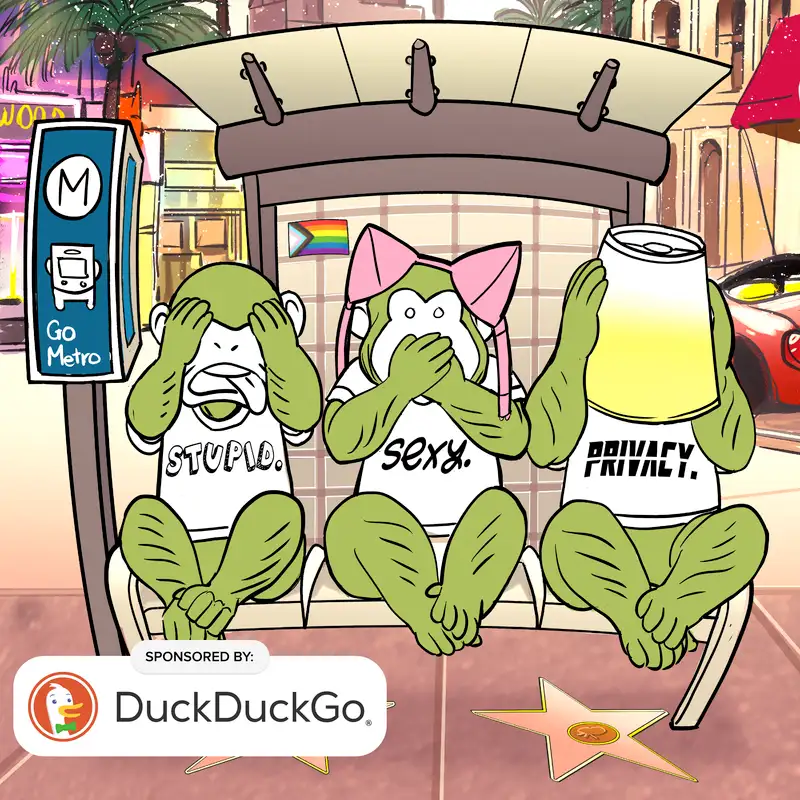
That's correct. The DuckDuckGo browser keeps your personal information protected. Say goodbye to hackers, scammers, and the data hungry companies. Download from DuckDuckGo.com or wherever you get your apps. Welcome to another edition of Stupid Sexy Privacy. A podcast mini series sponsored by our friends at DuckDuckGo. I'm your host, Rosie Tran. You may have seen me on Rosie Tran Presents, which is now available on Amazon Prime.
01:14
And I'm your co-producer, Andrew VanVooris. With us, as always, is Bonzo the Snow Monkey. I'm pretty sure that's not what a Japanese Macau sounds like. Oh, it's not. Not even close. Let's hope there aren't any zoologists listening. It's fairly simple. A lot of people think they're born better than others. I'm trying to prove it's the way you're raised that counts. But even a monkey brought up in the right surroundings can learn the meaning of decency and honesty. OK.
01:43
I'm also pretty sure that's not what a snow monkey sounds like. Over the course of this mini-series, we're going to offer you short, actionable tips to protect your data, your privacy, and yourself from fascists and weirdos. These tips were sourced by our fearless leader. He really hates when we call him that. DJ Mendelson. Episodes 1 through 33 were written a couple years ago. But since a lot of that advice is still relevant, we thought it would be worth sharing again for those who missed it.
02:11
And if you have heard these episodes before, you should know we've gone back and updated a bunch of them, even adding some brand new interviews and privacy tips along the way.
02:20
That's right. So before we get into today's episode, make sure you visit StupidSexyPrivacy.com and subscribe to our newsletter. This way you can get updates on the show and be the first to know when new episodes are released in 2026. And if you sign up for the newsletter, you'll also get a free PDF and mp3 copy of BJ and Amanda King's new book, How to Protect Yourself from Bastions and Weirdos. All you have to do is visit StupidSexyPrivacy.com.
02:47
StupidSexyPrivacy.com That's what I just said. StupidSexyPrivacy.com I know, but repetition is key to success. You know what else is? What? Bonzo, eat your pablum like a good boy and pretty soon you'll grow up to be a big strong handsome man just like your daddy.
03:08
then you'll have Swedish pancake too. I'm really glad this show isn't on YouTube because they pull it down like immediately. I know Google sucks. And on that note, let's get to today's privacy tip. oh
03:26
This week, BJ is joined by Dr. a licensed psychologist and founder of the Black Girl Doctor. Dr. Tai works with ambitious, high-achieving people to untangle burnout and emotional pain. So, success doesn't come at the cost of feeling empty inside. We wanted to talk to Dr. Caldwell Harvey about the impact of social media algorithms and AI on mental health, since there's a whole lot of people talking about that these days in the news. But, few of them are licensed psychologists like Dr. Tai.
03:53
So let's hear from an expert. Take it away, BJ. Dr. Tai, would you like to take a moment just to introduce yourself to our listeners? I would love to. Thanks for having me. My name is Taisha Caldwell Harvey. I go by Dr. Tai. I'm a licensed psychologist and the founder of the Black Girl Doctor. We are a virtual mental health practice specializing in a niche population.
04:20
And I've been doing this work for over 15 years and I'm excited to have a conversation around mental health. I feel like one of my specialties is translating the science of behind mental health into digestible nuggets that can help everybody. Yeah, I mean, I've seen a couple of interviews with you and I was like, yes, this is this is the person I want to talk to when it comes to this stuff. So I really appreciate you writing this back. ah Let's let's dive right into it. So.
04:49
I feel like mental health terms are becoming part of the everyday conversation. I, in particular, when I write about local politics for my other gig, so I use gaslighting quite a bit when it comes to ah what some of the local politicians say and do. But I know imposter syndrome is a big one and trauma is another one. I was hoping you can help us define these three terms in particular with what they mean versus what
05:18
how it may differ with how people use it online. Yeah. So I'm glad you started with gaslighting given and you already connected it to politics. So I will say so gaslighting really what we're talking about is a form of psychological manipulation where someone tries to make you question your own reality or your memory or your sanity. So you will usually walk out of an interaction feeling like
05:46
Am I losing it? Is anyone else hearing what I'm hearing? Does this make sense? I call it like the get out moments for those who've seen that movie. ah But I also just, I like to also share that there's collective gaslighting. So a lot of times when I hear folks talking about it online, it's more like in relationship one-on-one with people, but we also see it at a systemic level. And so when an institution is denying or minimizing experiences of harm,
06:14
And so we can talk about like racial trauma, sexism, homophobia, like all the isms. Like we see it there too. And so people are told you're overreacting. Oh, it's not about your cultural identity. um It's not discrimination. That can also be gaslighting. So it's interpersonal, but it's also structural. And let's talk about imposter syndrome because I see that one a lot as well. Yeah. So imposter syndrome really
06:43
And this always gets me going because when I first learned about this, um, this word and this phenomenon, uh, it was, I was in school and graduate school and it made so much sense to be able to have a word to define an experience that I saw a lot in the clients I was working with. Um, and I think the way popular culture has kind of taken it and they've really put like a negative spin on it.
07:09
But imposter syndrome describes this experience of you doubting your abilities or feeling like a fraud in a situation. So yeah, so you might be really capable and accomplished, but somehow you end up feeling like a fraud. And a lot of the times this, I think what popular culture has done is taken this and said, oh, it's because you lack confidence, right? And you just need to, if you had more confidence, you could get over it. But what we're actually seeing in imposter syndrome is that it's a logical reaction.
07:38
to systemic exclusion or like real experiences that are happening. So if you're a woman and you walk into a room and you are the only person of your gender in there and you start picking up on cues that maybe you aren't supposed to be here. And sometimes there are spaces where those cues really do exist. And uh that's just the reality of it. And if you're a healthy person, you're supposed to pick up on those cues. And so what it is by having this term,
08:07
you have other language to describe what it is, except for just feeling like you must not belong. Right. So you have more ways to interpret what's happening to you. Yeah. And the last one that we see, and this is probably the one that I think ranks number one, I had a, like, yes, I think is definitely like number two. But number one is trauma. Like I see that used a lot online and sometimes I wonder if the definition is what people think it is.
08:34
Yeah, so trauma, if we can go to the simplest terms, it's what happens inside of you as a result to what has happened to you. And so it's not necessarily the event itself, but it's how your mind, your body, your spirit is responding to experiences. But we can all experience traumatic events. And that's a little bit of a nuance there. So
09:00
things can happen to us that things do happen to all of us that overwhelm our ability to cope. We can experience traumatic loss. We can experience violence, abuse, like all sorts of things. I will say folks that were, you lived through the pandemic, you lived through a traumatic experience. Yes, absolutely. And then, but also what's true is that two people can live through the same experience and have different outcomes. So for some that could lead to a trauma response.
09:29
And for others, they could come out of it completely fine. And whether or not, who that happens to is circumstantial and also there's some biological components to that. And then in psychology, there's things we know that can help buffer the impacts of somebody having like a traumatic response to a traumatic experience. And so let me ask you, when we use these terms and we see them, is this an example of
09:57
language evolving over time? Or is an example of, know, maybe we need to build a better vocabulary for what we're feeling if these terms don't fit how they're being used. Yeah, I this is such a interesting maybe that's the word I'll use a question for me, because I think there's, you know, there's just good happening. And then it's almost like there's a pendulum swing where I feel like we went too far on one end. And so
10:26
What I'll say is that I think that more people using the language reflects that there's this cultural shift in our society where people are trying to grow their emotional intelligence. More people are hungry for mental health language and words to describe how you feel, which is actually what psychologists have been trying to get people to do for decades.
10:51
talk about your feelings and now people are and we're like, whoa, whoa, whoa, wait a minute, not like that. And so I think we want to lean in a little bit because we saw, we know the damage of stigma, right? So we have, I think historically like boomers, Gen X, even some older millennials, um which I am an older millennial. Okay. Yeah. Yeah. So some folks don't talk about mental health. Like those words are taboo. They're off the table.
11:20
Um, and, and that's kind of how we, the world we grew up in. And then we now have younger millennials. got Gen Z, we got Gen Alpha and they're like, no, I'm going to tell you everything and I'm going to film it. And so again, if this pendulum swing, they went all the way the other way, like, don't, don't make me be quiet. I'm going to tell you how I feel. And I think in some instances it's reducing shame. It's reducing the stigma so more people can talk about it. Um, what I love when I'm seeing online is people.
11:50
You know, you may, when you're suffering with something, a lot of the time it feels like you're the only one. so to, you know, get on social media and see somebody else sharing their story and crying and they're feeling the exact same way you're feeling or really similarly to where you're feeling. And there's language to talk about it. That is super empowering. can be. Absolutely. And that's something we talk about quite a bit on the show. Uh, you know, our, our sub theme is how to protect yourself from fascists and weirdos.
12:18
And one of the ways to do it is to remind yourself that you're not alone. Yeah. And that's powerful. There is power in community. That's where people are finding each other. Right. And then but you know, and so while that's powerful, if you are somehow now shaming people in that experience, or if you are providing inaccurate information that could lead people to further
12:45
leave people down a route of further harm, that it can be just as powerful in the opposite way. Right? Yeah. I think what's what's troubling is that there's no correlation or relationship between the accuracy of information and how viral something goes online. Yes. Right. And I'm just like, that is the place where I wish that can be solved. wish if somebody anybody could say anything on the Internet and I struggle with that.
13:15
Yeah, like I'm here for freedom of speech, but how do we protect people from harm? Right? And how do you stop something from spreading so virally as if that means it's true and it's just not true. It's just not. Yeah, it's inaccurate. And let me ask you, you made I think it was with the the APA. You made this great point where you were saying, you know, a lot of resources out there for people are locked up like they're behind the paywall.
13:42
Yeah. Or during an academic journal, which might be impenetrable for a lot of people. But in terms of like building that vocabulary or in terms of maybe getting us to. not that I appropriately isn't the right word, but but getting us to sort of discuss these things in a way that that might be more productive. What are resources you recommend to people instead of people going out and finding these terms on social media? Yeah. So I will say one of the things
14:12
I think AI is doing good, is providing definitions. I saw, and again, yes, a lot of psychological journals and research, they're behind paywalls, which is a whole nother conversation we could have. How do you do the research, find the evidence, and then lock it behind a paywall from the public? again, I won't go down that route at the moment. But.
14:38
Uh, so some studies came out this year showing that one of the top searches people are using or how they're engaging with chat GPT is for therapy. And while I don't think that we should be doing that for lots of reasons, um, your privacy, um, which probably a good topic again for this podcast. But, um, one of the things AI does do well is tell you what things mean. Right. And so.
15:05
to be asking questions em before, when you think about content creators or just anybody in general, when you're having a conversation with somebody, maybe you just ask, like, what does gaslighting mean? And when I, I definitely am engaging with AI. And so when I use it for information like that, I think it does a pretty good job. em But also, so yeah, one thing I would say is that, you know,
15:32
lean into the technology that's there, you can actually ask a question and say, give me the evidence based definition for this word and tell me how it differs from differs maybe from how we see it used in popular culture. And I, in uh my research, I think it does a really good job of that. m But also I will say following and listening to um to podcasts to
15:59
social media content, including your feed, licensed mental health experts. So I'm happy to share a few, but there are tons of really great psychologists or mental health providers who are full blown content creators and they are making incredible content talking about all of this. Yeah. Dr. Tracy Marx is one of my favorites. Ah, okay. Yes. You too. She's very good. ah
16:27
I was going to say so Dr. Tamah Bryant is really fantastic. She's a trauma psychologist and it sounds very depressing, but it's not. Her content is so uplifting. Dr. Julie Smith is fantastic. She does a lot of like little examples where she talks about all these concepts and then she does little experiments to demonstrate what they mean. uh So I can go on Dr.
16:52
I could go on, but happy to share a few. But yeah, there's people making really great content that's engaging and fun. And I think if you could just throw a few of those into your feed, it would help. Absolutely. I mean, we talk a lot. We're a little seeky. We're always kind of putting out politics into the show, right? So we're constantly talking about universal Medicare access for everybody, health care for all. And one of the reasons is because mental health is something that isn't always covered or
17:20
It can be very expensive. so one of the reasons I wanted to talk to you was, I'm sure there's people right now in the United States at the time that we're recording this that are very concerned about what I call the Mag and Burner bill, kicking them off their health insurance. And we're recording this during the government shutdown where over a million people could also lose their health insurance. so one of the things I wanted to talk to you was
17:50
So we talked a little bit about chat GPT. else? mean, and we mentioned following people who are, you know, influencers, but also licensed therapists. But what are some of the other things that people could do if they're in a situation where all of sudden, you know, let's say they're like me and they have OCD, you know, and I've been fortunate to have a therapist, but let's say they're not. What are some of the things that they could do if they're in a situation where they don't have that coverage to go and see a therapist?
18:20
Yeah, so this is, it's a, there's so much happening right now in terms of the, I don't know if I want to call it the infrastructure or just like the business behind mental health. And there's so many places that need, that need change that need to be revolutionized. I think everybody deserves access to high quality mental health care. I see all of these companies that are popping up.
18:49
A lot of them, don't think they're doing a very good job. They're offering extremely low cost therapy. And I'm thinking about my words right now. Yeah, no, we all are. every interview that we've done so far in 2025, everyone is like that. Everyone's been like, let's process everything before we continue. I totally get it. Yeah.
19:18
So one, will say there are a lot of organizations doing good work in providing, finding ways to provide care to people. whatever communities you're a part of, I would say to research uh nonprofit organizations that may be providing access to care. em And so again, I'm seeing lots of nonprofits that are getting funding, usually private funding, to then give people vouchers for therapy or offering therapy sessions.
19:45
Another low cost option or lower cost option is group therapy. And I think that for some people, m people really shy away from it. And I think the pandemic made people really comfortable with being isolated and doing everything on their own. But group therapy in a lot of instances is more can be more effective than one on one. Because what it does is it gives you an opportunity to practice what you're learning.
20:13
and the new ideas and ways of being that you're trying out, it gives you an actual place to try them out in a therapeutic environment em that is safe for you. So again, it's one of the ways like if you wanted to stay in care and you needed to reduce your cost, groups is a really good option. I would also say that therapy isn't the only way to cope with mental health challenges. And so think about all of the different things that help you
20:43
feel better and more connected to yourself. So community in general. So what we know is that being connected with other people em is effective. thinking outside of the therapy room. So if you can create space where you are with friends and family for a certain amount of like increasing your ability to do that, that actually has a positive impact on your mental health. If you are religious or spiritual,
21:10
So connecting with that community, a faith-based community, whatever it may be, we know that has a positive impact on your mental health. Doing things like being mindful of your diet, exercise, your, so when I say exercise, moving your body. So we're going back to basics, right? So like we can all do the basic things that improve your mental health. Those things actually help.
21:39
I will also say engaging with your cultural identity. so people don't think about this often, but you have, I think we always talk about, I don't know, cultural trauma that people inherit. But we also all inherit cultural strength. um And if you're here, that means your ancestor survived something, which means that you inherited their persistence, their resilience. And one of the things we know that is a buffer against trauma, that is a buffer against the
22:08
and negative symptoms of mental illness is to ground yourself in your culture. So that means, you know, watch, read things, watch things, listen to music. That is a reflection of who you are as a matter of fact, not like a, not like a, this is how I strive to be, but I always ask people like, who am I? Which is just a factual question. Where did you come from? Who are your ancestors? uh And connecting more closely intentionally with those things also has positive impacts on your mental
22:39
Our co-producer, BJ Mendelson, and my co-host, Amanda King, just put out a new book that you really need to read.
22:45
It's called How to Protect Yourself from Fascists and Weirdos. And this book delivers on what the title promises. If you're worried about the fascist takeover of America, but don't know how or where to start fighting back, this book is for you. If you need practical tips on staying safe at a protest or filming law enforcement without getting indicted, we got you covered. And because life isn't all about the crisis of our time, BJ and Amanda even cover how to protect yourself offline for moments like when you realize your date is a total weirdo.
23:12
The best part? This book is absolutely free! Just head on over to StupidSexyPrivacy.com and click or tap on the word book. Now let's get back to our interview, already in progress.
23:25
Absolutely. so the flip side to this is going to be, know, what let's about some of the problem areas with how social media can contribute to misinformation about mental health. um How big of a problem is self-diagnosis uh from people just reading stuff on the internet? Yeah, it's bad. It's terrible. I will say. answer. Yeah.
23:54
We transferred all of the, what is this, the WebMD self-diagnosis into, I don't know, social media and mental health diagnosing. I will say, so in the studies that have come out, I think maybe some of the more, the larger studies. So the Guardian published an article and they looked at the top 100 TikTok videos around mental health. And they said, what did they say? um
24:25
They only found that over 50 % of the information was inaccurate. Wow. And then the other study that actually came out first, it was from Plush Care. did a study. They looked at 500 TikToks and they looked at ones that were actually tagged mental health tips or advice. And so these people actually put this with the intention was to give tips or advice and 84 % of it they concluded was misleading with 31 % of that being completely inaccurate. Wow.
24:53
And when they looked at ADHD was the most problematic category and they said a hundred percent of the content in that area contained misleading information. And is that, is that because people don't realize, so like going back, I'm just using myself as an example. Um, you know, when you have OCD, you have, or you could have ADHD like symptoms. it, so is that sort of, uh are people confusing the two in trying to be helpful? don't like, are they like intentionally being
25:23
misleading. Yeah. the majority of, there are people out there that are intentionally being misleading, but I tend to like not focus on that part because I think you'll always have that, right? You'll have people that are intentionally just trying to be sensational and like, they don't care if the information's accurate. But when you're looking at people that are genuinely trying to help one, you have non-licensed non people without any mental health background creating content, which I think is problem number one. And so
25:52
what usually you'll find is people will share what they experience and they will share it as if it is fact. Right. And so my experience of anxiety does not mean I now know what a person with anxiety disorder experiences. Right. Yeah. I feel like it's very, uh, it's a self centered, um, in, in defining the word in that way, just very self.
26:21
centered way of thinking about things. It's taking this perspective of, because this happened to me and this is what I did and it worked for me, my experience deserves to be centered as what is true for everybody who has this thing. And that is literally just not how human behavior works. Right. Yeah. We're constantly telling people when we talk about disinformation, misinformation that
26:48
Now, what's true for you isn't going to be true for the person sitting next to you. Everyone is different. It's a broad spectrum of humanity. You talk about billions of people. what do you... Oh, sorry, go ahead. Yeah, I was going to say what psychology does in the field of psychology does is it studies like hundreds and hundreds and millions of people and it looks for...
27:14
similarities that it can cluster together to create a diagnosis, which is really helpful because then we can, you know, work on how, how can we improve these symptoms, right? And we know what works because we know what's worked for thousands of people, right? But if we did it on a single person, like the effect wouldn't be the same. And that's like, why would we talk around, you know, wanting to get information from somebody
27:40
who was actually using evidence-based research, um education to give guidance because it's more likely that it's going to work for you. And I think even in that, it's not a, it's uh science and there's art to it. And even in a diagnosis, m I need to be, as a psychologist, I need to be able to understand what are the core, um
28:07
the core features that this person's, the symptoms this person is experiencing, does it fit in any of these clusters? But even if it does, like I still, you're still tailoring the experience to this one person's experience. em Yeah. And that's, that's like, that's what makes it work. Right. I can't, if I told two people the same thing and expected it to work, you can just all read a book. That's very true. Very true. One, guess, yo, let's, let's assume that people
28:37
that someone else saying does have access to a therapist. When would you need to see a therapist as opposed to like, you're on doc.go or you're on Google or you're just using ChaiGPT. Like what is that threshold between looking stuff up and then the need to go see someone? Yeah. So I think looking stuff up is great in that you want to empower yourself to say like, you you're looking for an answer to give you a direction. Like maybe.
29:06
maybe I should go here. Like, oh, I think what I'm experiencing is sounds like there might be some anxiety here. And that's helpful because then you can at least look for a therapist that, you know, is a specialist in anxiety, right? And that might be better than you looking for a therapist that's a specialist in, I don't know, eh or something different, right? So it gives you a little bit of direction. But when I consider, I think about as a threshold,
29:35
is this distinction between struggling versus suffering. And I explain this in that a lot of the time people say I'm struggling, oh, the struggle is real. I use that language a lot. It's hard out here. And all of that is true. And when I look up the dictionary definition of to struggle, it is to make a violent or forceful effort to restrain something that's trying.
30:04
to break yourself free from something that's trying to restrain you. Right. That's like the definition of struggle. Um, but when people use that language, a lot of the times that's not what's happening. They're actually sitting with pain. Um, and that is the definition of suffering. Right. And so literally the definition of suffering is to like indoor, you know, pain, hurt, discomfort. Right. And
30:32
in the mental health world, what we consider the threshold from struggling with something to suffering with something is really this duration. So obviously there's an intensity component. em But, and I can talk about that too, if we have more time, I like to use a one to 10 rating scale. em But when you're sitting with pain for a long time, and what we consider a long time is two or more weeks.
31:00
And it's not necessarily like, oh, I'm, I'm sad ish for two weeks. Let me go see a therapist. I like to think of it as, um, I've been struggling with something. I've been experiencing pain. When I noticed it, I attempted to do the things that are, you know, the ways that I know how to help myself. Um, and so again, I don't think everyone's first instinct should be, let me run to therapy. I think you should try the things that you know.
31:30
Make you feel better. Hey, like are you are you completely isolated? Go sit with your friends like have you are you rested? Are you burnt out? Did you take a break? Right? Like do those things? Have you slept? Are you eating? Okay, do the things that you know, like should have an impact um If those things aren't working for two weeks, you should see somebody because that's one of the indicators of needing more of an intervention is that
31:57
you're not responding how you typically would to things that typically improve your mood. Right. And so we're almost out of time. So before we go, I really wanted to ask you about the Black Girl Doctor. It's an awesome initiative. I was just hoping you could tell us a little bit more about it and how people could take advantage of the resources. And how can we find you? How can we support your work? Yeah, absolutely. Thank you. Yeah, so.
32:25
The Black Girl Doctor is a company I started in 2017 after I had been doing this work, but also experienced burnout myself multiple times. And as a professional black woman, one of the things I struggled with, and I know that community struggles with, is finding mental health care in a population that is often overlooked. And as a result, we end up sacrificing your joy.
32:53
em I really see joy as a social justice issue. I think all people should have a right to experience a full range of emotion, which includes joy and happiness. And so I chose to start a company that focuses on a niche population and ensuring that they can be successful. They can make change in the world and also have joy at the same time. So that's the work we do. We offer therapy, wellness, coaching, and events, and you can find us everywhere.
33:21
at theblackgirldoctor.com. We're on social media and LinkedIn, all the places. That's fantastic. It's truly just an awesome thing you're doing. Thank you. Thank you.
33:37
There are two economies in America, one for the wealthy and one for you and me. And the one for you and me resembles what used to be called a third world country. These days, we more politely call them developing countries, and we should. Because with the way things are going, those developing countries are soon gonna kick our ass and offer things like universal healthcare coverage. So.
33:56
We know managing your privacy, data security, and anonymity can get expensive, which leads to the question, what's the least you can do to get the most in protecting yourself from fascists and weirdos? We'd like to recommend the following. Use Signal for all text messaging with your friends, family, coworkers, and fellow protesters. Do not use WhatsApp. Use Bitwarden to manage your passwords. And last but not least, get the DuckDuckGo subscription plan.
34:21
For about $10 a month or around $100 a year, DuckDuckGo offers a solid VPN identity theft restoration protection, private access to advanced AI chat models, and a data removal service.
34:32
These four items are often sold separately for way more than $100 a year. And $100 a year is way less than what you spend on virtually every streaming service. You can sign up for DuckDuckGo subscription via the settings menu in the DuckDuckGo browser available on iOS, Android, Mac, and Windows. Or via the DuckDuckGo subscription website, DuckDuckGo.com slash subscriptions. The DuckDuckGo subscription is currently available to residents of the US, UK, EU, and Canada. Feature availability varies by region, but your peace of mind will not.
35:02
Because supporting companies like DuckDuckGo is one of the key ways we can defeat fascists and weirdos. Don't support companies that support fascists and weirdos, support DuckDuckGo instead.
35:15
you
35:20
This episode of Stupid Sexy Privacy was recorded in Hollywood, California. It was written by B.J. Mendelsohn, produced by Andrew Van Vorse, and hosted by me, Rosie Tran. And of course, our program is sponsored by our friends DuckDuckGo. If you enjoy the show, I hope you'll take a moment to leave us a review on PocketCast, Apple Podcasts, or wherever you may be listening. This won't take more than two minutes of your time, and leaving us a review will help other people find it.
35:45
We have a crazy goal of helping 5 % of Americans get 1 % better at protecting themselves from fascists and weirdo. Your reviews can help us reach that goal, since leaving one makes our show easier to find. So please take a moment to leave us a review and I'll see you right back here next Thursday at midnight. After you watch Rosie Tran Presents on Amazon Prime, right? Bonzo, I wish that you'll have many more birthdays just like this one. With those you love and trust around you always to share your happiness.
36:15
And I wish that you'll get a chance very soon to prove that being loved and looked after like a human being has made you feel like a human being. And that if love can do that to you, then it ought to be able to make some other human beings human beings.
Creators and Guests